“He That Sweareth To His Own Hurt”

“He That Sweareth To His Own Hurt”

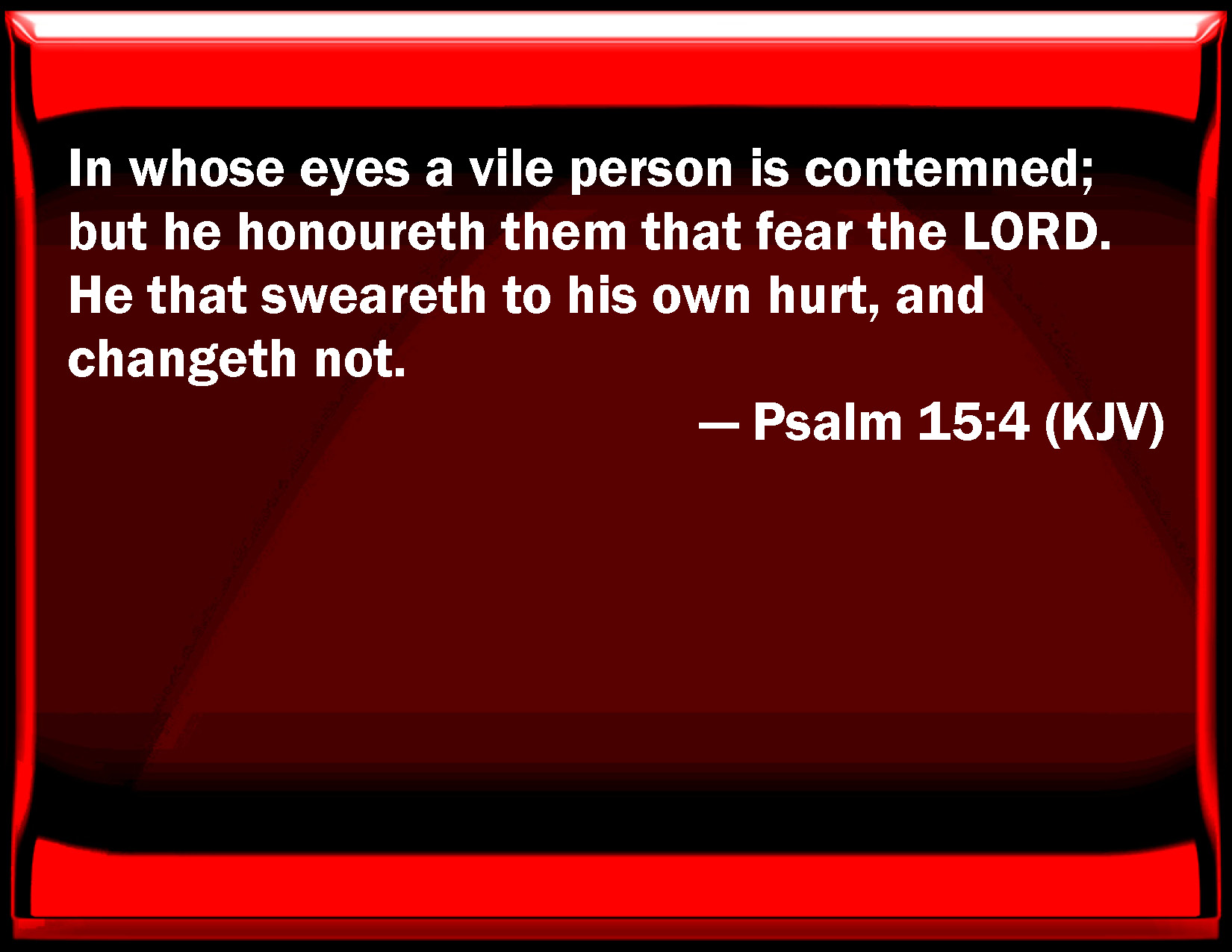
“LORD, who shall abide in thy tabernacle? who shall dwell in thy holy hill? . . .  He that sweareth to his own hurt, and changeth not.”  (Psalm 15:1, 4)hurt psalms
In the year 2000 I lost my job at EDS and began searching for employment.  I picked up some part time work in the interim.  While I was committed to a project, I got a call from the Compaq Corporation.  I scheduled the interview and met with a manager.

The job they wanted me to do was a “dream job” in the computer industry.  I would be technical support for the outside sales department.  I would get a company car, have access to a large computer lab facility, be able to take clients out for lunches on a regular basis at the company’s expense, and all the perks.

At the end of the interview, the manager looked at me and said, “I would like to hire you.  When can you start?”

I replied, “I have a previous commitment with another company to do a temporary project and in two weeks after that project is done, I can start.”  He said that he appreciated my honesty and character; we parted company and he never called back.

We live in a society that by and large values compromise above principle, subjectivity over objectivity, and relatives over absolutes.  It would be an understatement to say that it is easy to get away with not keeping one’s promises in our society.

“Things happen.”

The weather changes.  We don’t feel good.  Other people don’t follow through.  There are any number of reasons that we could enumerate, and by and large most would accept our excuse.

In contrast to our society, God’s people, God’s society, are called to a higher standard.  It is a standard that transcends the bounds of society, time, and culture.  It is a standard based upon the eternal character of God.  It is a standard upon which God expects us to live (Romans 12:1-2).

Our God is a God who always keeps his promises (Hebrews 6:17-18, Titus 1:2).  If we desire to dwell in His holy hill, His tabernacle, His church today, we must practice His standard of righteousness.  When we are willing to suffer to keep our promises, God says that is when we are most like Him.

May we, as God’s people, resolve to keep our word and dwell in unity with our God.

Posted in Kevin Cauley | Tagged , , | Comments Off on “He That Sweareth To His Own Hurt”

America, Hope, and the Valley of Achor

America, Hope, and the Valley of Achor

The parallel between the demise of the Jewish nation as they headed for captivity and the demise in our land is so striking. We know specifically that God had chosen the nation of Israel and brought them into a land flowing with milk and honey. The remarkable history of America and its elevation to being a world power in it such a short time is almost unheard of in world history. We are not God’s chosen nation, but we have been brought into our land of blessings.

Look carefully at how the Jews responded to their blessings. They lived in the abundance He gave to them, but almost immediately forgot about the One who gave them such blessings. Our land was born under the banner being one nation under God. Isn’t it remarkable how our nation is now doing all it can to be one nation out from under God!

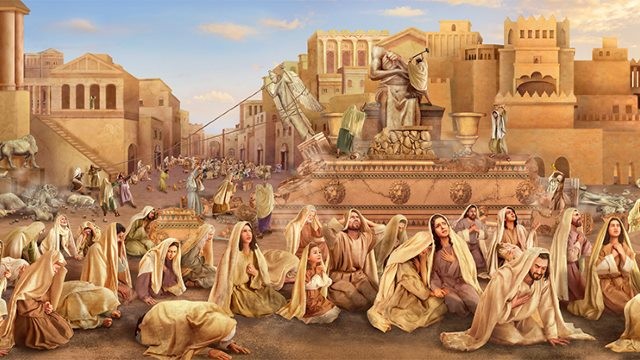
As the northern kingdom of Israel was about to be destroyed God sent His messenger, Hosea, to make a final appeal. What was that message? Where could that nation who had left God find in hope of reconciliation? Hear the words of Hosea. “I will give her…the valley of Achor as a door of hope” (Hos. 2:17). The hope of Israel was to be found in a valley that was part of the birth of that nation (Josh. 7).

The young nation of Israel had just captured the city of Jericho as God collapsed the walls of that fortified city. He was with them! The joyful prospect of now conquering the rest of the land with God’s help was within the heart of every Jew. God had promised that land to Abraham, Isaac and Jacob and now He was giving it to them. The pagan nations seemed powerless before Him. To the Jews’ amazement, they came to the next city, Ai, and were soundly defeated. What had happened? The answer is found in the valley of Achor.

The nation was not aware that one man had taken some of the spoils of Jericho which had been sanctified as belonging to God and hid them in his tent. The small village of Ai had routed the mighty army of God. Why? Because of the sin of one man. How did God look at that sin? He made it an example for every Jew as they conquered the rest of the land.

What did they do to this man? More importantly, where were they when they dealt with the sin? They stoned that man, Achan, and his entire family. They burned all his possessions and raised a heap of stones as a “memorial” to the importance of dealing with sin. Where was the monument? It was in the valley of Achor (Josh. 7:25-26).

That valley was the only hope Israel had of surviving in Hosea’s day. Their failure to deal with sin was their demise. America has left God. Perhaps it is time we go the valley of Achor and find the only hope we have!

Posted in Dan Jenkins | Tagged , , | Comments Off on America, Hope, and the Valley of Achor

Jonah Chapter 3

Jonah Chapter 3

Jonah Chapter 3 records Jonah’s trek into Nineveh.  He survived the belly of the great fish through the hand of God.  Now, he is a walking sign.  A man by whose offering to the sea immediately resulted in their calm.  A man who should be dead having spent three days and three nights in the fish.  Did the men on the ship see him swallowed up?  Did those same men relay the tail of what happened to any of the Ninevites?Nineveh repent

Jonah Chapter 3 features a lesson in repentance.  It is not merely a momentary verbal, acknowledgement of the engagement in evil.  It is far more.  John the immerser once cried out to the Pharisees and sadducees to bear fruit with their repentance (Matthew 3:8).  Nineveh would be held to the same standard.

When a nation repents, as Israel did often, the repentance typically came from the leadership first.  Throughout the Bible, this is a reoccuring occassion.  The sign and prophetic speech of Jonah would once again spur on these results and do so in the hearts of the Ninevites.  Sadly, generations afterward did not heed their example.  The Book of Nahum is an excellent follow up read to the book of Jonah.

Posted in Video | Tagged , , , | Comments Off on Jonah Chapter 3

Don’t Bear False Witness

Don’t Bear False Witness

“A man that beareth false witness against his neighbour is a maul, and a sword, and a sharp arrow.” (Proverbs 25:18 KJV)

To bear false witness against one’s neighbor is to lie in such a was as to implicate them in wrong-doing or as an assault on their character. It is to slander or libel against someone with a desire to destroy them. Sometimes motivated by greed or envy and sometimes as a means of covering one’s own tracks. The Ten Commandments forbade this type of assault on the character of another person.false witness tongue

The writer of Proverbs, clearly has in view the bearing of  false witness as an attack employing three avenues. A “maul” is a club or a “war hammer” used to smash an opponent with great violence. It is a weapon of brute force and requires only great physical strength to wield, but little actual skill. Bearing false witness is like wielding a club in that it can be indiscriminate and the wielder keeps swinging until he hits something. It is similar to the idea of, “Throwing stuff at the wall to see what sticks.” Bearing false witness can sometimes take a form similar to swordsmanship. This type of false witness is as a swordsman who wields his weapon with the precision and skill of an expert character assassin – they wait for the right moment and go straight for the heart. A man bearing false witness can also be like an archer. He shoots from long distance and, if possible, from behind. Those who bear false witness rarely do so where the one whose character they are seeking to destroy can see them. They shoot their false accusations, talking  behind their victim’s back employing rumor, gossip, and insinuation as their arrows.

False witness was responsible for Joseph’s imprisonment and for Daniel’s visit to the lions’ den. When the Jewish leaders could find nothing in Jesus as a legitimate legal excuse to have Him crucified, they had to resort to hiring false witnesses. The false witness suborns justice, perverts the truth, and destroys character. The child of God must not be a false witness, even inadvertently. Similar to President Truman’s motto, “The Buck Stops Here,” the child of God who hears rumor, gossip, or insinuation must not pass it on.

Read Exodus 20:16; Matthew 15:19; Mark 14:53-65; Romans 13:8-10

Posted in Jack McNiel | Tagged , , , , , | Comments Off on Don’t Bear False Witness

The Chain Gang isn’t Glamorous

The Chain Gang isn’t Glamorous

The world tries to make sin a glamorous thing. Many years ago, there was a song about the men working on the chain gain. The lyrics of that song said: “That’s the sound of the men working on the chain gang.” The song sympathizes with their plight talking about how they work so hard and just want to go home to their family. Maybe this is true, but the song doesn’t talk about why they are on the chain gang to begin with. Maybe they took the life of someone else’s family member. Maybe they robbed a small business and destroyed someone’s livelihood. There is a reason the men working on the chain gang are working there, but the song doesn’t mention that. Why? Because there’s nothing attractive about robbery, murder, and its just punishment.Chain Gang

Why sing about those men working on the chain gang then? Such songs create sympathy for those who are being justly punished for the crimes. They also lessen in the public mind the seriousness of the crime that they commit. Years of sympathizing with sin has so cheapened sin that no one thinks anything about it when it is reported. This leads tolittle retribution, and much licentiousness.

Sin is a horribly ugly thing, but Satan wants us to think it’s no big deal. He uses every means available to try to convince us of that. How do we know sin is horrible? Look at the price paid for it—the death of the Son of God. If you don’t think that was horrible, just read about the process of crucifixion sometime.Remember, “In due time, Christ died for the ungodly” (Romans 5:6) Don’t cheapen Christ’s sacrifice by glamorizing its cause.

Posted in Kevin Cauley | Tagged , , , | Comments Off on The Chain Gang isn’t Glamorous