
The Wheat and the Tares
Why the Evidence Favors the Final Judgment
Introduction
The Parable of the Wheat and the Tares (Matthew 13:24-30; 36-43) is one of the few parables Jesus explained in detail. While nearly every figure is identified, one important question remains:
Does the harvest refer exclusively to the destruction of Jerusalem in A.D. 70, or does it describe the final judgment of mankind?
This paper does not deny the significance of A.D. 70. The destruction of Jerusalem was one of the most significant judgments recorded in Scripture and occupies an important place in the teaching of Jesus. The question is whether the Parable of the Wheat and the Tares finds its fulfillment exclusively in that event.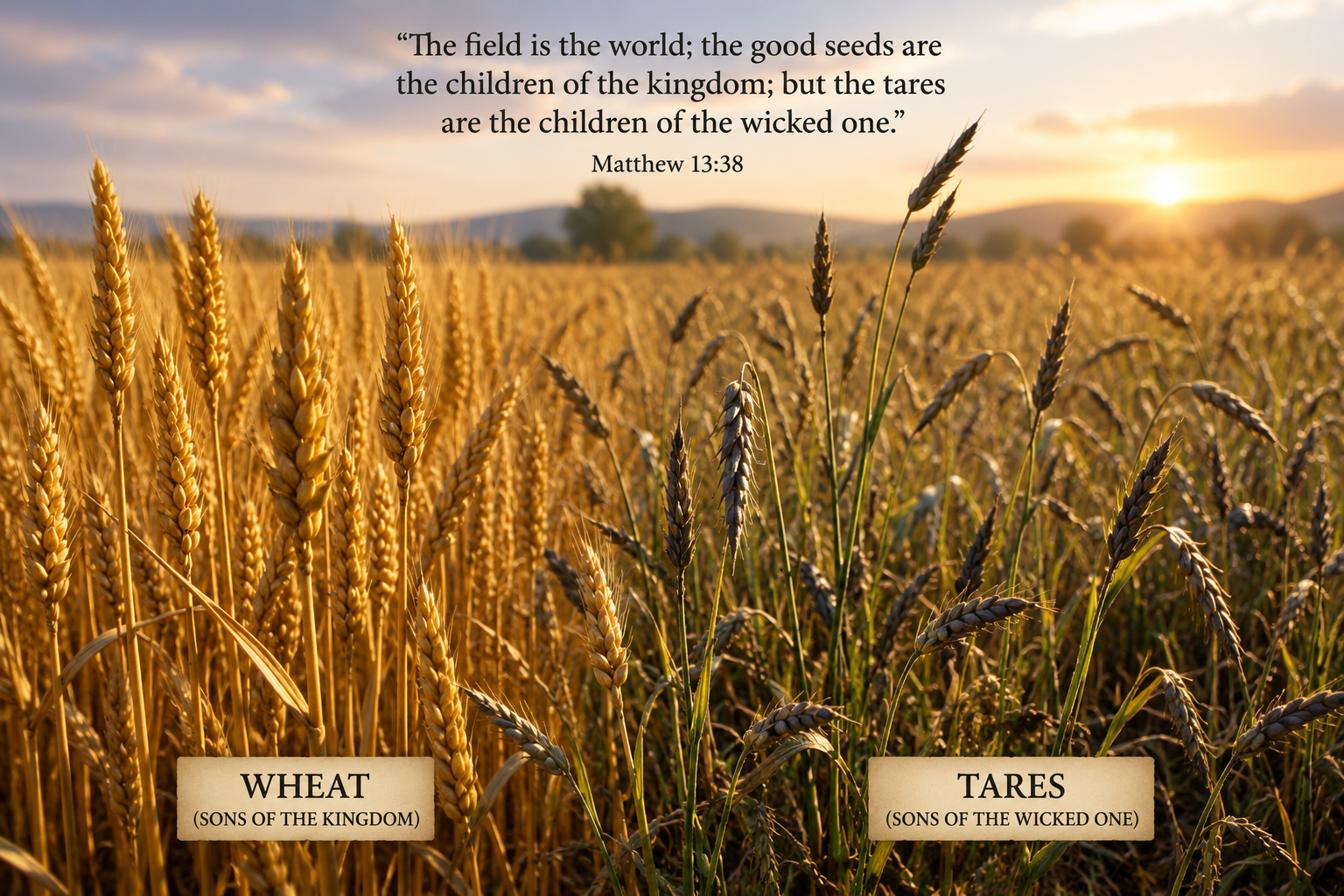
The thesis of this paper is straightforward:
When Matthew’s own use of judgment language is allowed to interpret the Parable of the Wheat and the Tares, the cumulative evidence strongly favors the harvest as the final judgment rather than an exclusive fulfillment in A.D. 70. While an A.D. 70 interpretation remains possible, the probability is significantly outweighed by the evidence within the Gospel itself.
Rather than beginning with disputed prophetic passages, this study first allows Matthew to define one of his own recurring expressions – “weeping and gnashing of teeth.” Once that expression is established, it becomes an important guide for interpreting the parable. This study proceeds upon a simple principle of biblical interpretation: conclusions should be drawn from the cumulative weight of Scripture rather than from isolated passages or disputed expressions.
Matthew’s First Use Establishes the Pattern
Matthew 8:11-12
Jesus declared:
“Many shall come from the east and west, and shall sit down with Abraham, Isaac, and Jacob, in the kingdom of heaven. But the children of the kingdom shall be cast out into outer darkness: there shall be weeping and gnashing of teeth.”
Matthew establishes several important truths.
- Abraham, Isaac, and Jacob are present in the kingdom.
- Many from every direction are gathered to them.
- The sons of the kingdom (Faithful Israel) are excluded.
- Those excluded experience “weeping and gnashing of teeth.”
Jesus does not explicitly identify the timing of this gathering. However, the context provides a necessary inference. Abraham, Isaac, and Jacob had long since departed this life. Therefore, the gathering described cannot be an ordinary earthly assembly.
More importantly, Scripture knows of only one gathering in which God’s redeemed are united with the faithful who have already departed this life – the consummation of God’s kingdom. Nothing in the context suggests a figurative description of Jerusalem’s destruction or any other national judgment. Matthew therefore establishes the first occurrence of “weeping and gnashing of teeth” in connection with exclusion from God’s kingdom following the gathering of His redeemed people. Unless a later context clearly requires another meaning, this becomes the natural understanding throughout the Gospel.
Matthew Consistently Uses the Expression
Matthew 13:42, 50
The expression appears twice in Jesus’ explanation of the Wheat and the Tares. The wicked are separated from the righteous, cast into the furnace of fire, and there is “weeping and gnashing of teeth.” Matthew introduces no new definition of the expression. Nothing within the immediate context suggests that “weeping and gnashing of teeth” should suddenly be understood differently from its previous use. The issue is therefore not the meaning of the expression, but the timing of the harvest.
Matthew 22:1-14
The Parable of the Wedding Feast spans several stages of redemptive history.
- Israel rejects the invitation.
- The king’s servants are persecuted.
- The city is destroyed.
- The invitation is extended to all.
- Guests are gathered from every direction.
- The king enters to inspect the guests.
One guest is found without a wedding garment and is cast into outer darkness where there is “weeping and gnashing of teeth.” Although the parable includes the destruction of Jerusalem, the final inspection is of an entirely different character. Scripture knows of no historical occasion in which those gathered from among the nations into God’s kingdom are individually examined by the King and cast out of His presence. Rather, the scene naturally corresponds to the final accountability of all who have accepted the King’s invitation. Matthew therefore continues using the expression exactly as it was introduced in chapter eight.
Matthew 24:45-51
The Olivet Discourse begins with Jesus’ prophecy concerning the destruction of Jerusalem. Matthew records numerous observable signs by which believers could recognize the approaching judgment. These include:
- the abomination of desolation,
- the flight from Judea,
- unparalleled tribulation,
- and the shortening of those days.
These signs enabled faithful disciples to recognize the approaching destruction and escape Jerusalem before its fall. The discourse then continues. Jesus says:
“Then if any man shall say unto you, Lo, here is Christ…” (24:23)
If verse 23 marks the continuation of the chronology beyond the description of Jerusalem’s destruction—and the sequence of Jesus’ time statements appears to indicate that it does – then verses 23-28 naturally describe an intervening period characterized by false Christs and false prophets before the appearance of the Son of Man. Jesus then declares:
“Immediately after the tribulation of those days…” (24:29)
The question naturally becomes: Which days? If the chronology has continued beyond Jerusalem’s destruction, then “those days” refer to the period just described – a period marked by deception and false teachers. Only then does Matthew record:
“Then shall appear the sign of the Son of man in heaven…” (24:30)
Unlike Jerusalem’s destruction, whose approach could be recognized through observable signs, this appearance is followed not by further signs but by repeated exhortations to readiness because the exact time remains unknown. This progression is significant. Jerusalem’s destruction was preceded by observable signs. The coming of the Son of Man is not. Rather than giving additional signs, Jesus moves toward an entirely different emphasis. He declares:
“Of that day and hour knoweth no man…” (24:36)
and
“The Son of man cometh at an hour when ye think not.” (24:44)
The Parable of the Faithful and Evil Servant conclude this section. The servant is judged, not because he failed to recognize prophetic signs, but because he was unprepared for the unexpected return of his Master. Matthew concludes:
“The lord of that servant shall come… in an hour that he is not aware of… and shall appoint him his portion with the hypocrites: there shall be weeping and gnashing of teeth.”
Whether one ultimately agrees with this understanding of Matthew 24 or not, the argument presented here rests upon the chronology of the discourse itself rather than upon an external theological system.
If the discourse has indeed progressed from the sign-filled destruction of Jerusalem to the signless coming of the Son of Man, then this occurrence of “weeping and gnashing of teeth” naturally belongs with Matthew’s other descriptions of final accountability.
Matthew 25:30
The Parable of the Talents concludes with the unprofitable servant cast into outer darkness where there is “weeping and gnashing of teeth.” Immediately afterward Matthew records the judgment of all nations (25:31-46). The literary connection is striking. Matthew’s final occurrence of the expression stands immediately before the universal judgment scene, reinforcing the understanding established in Matthew 8.
Matthew’s Literary Pattern
The expression “weeping and gnashing of teeth” becomes one of Matthew’s recurring descriptions of divine judgment. From its first occurrence in Matthew 8 through its final occurrence in Matthew 25, Matthew repeatedly employs the expression at the climax of scenes involving separation, exclusion, and accountability before God.
| Passage | Setting |
| Matthew 8 | Exclusion from the kingdom |
| Matthew 13 | Harvest and separation |
| Matthew 22 | Exclusion from the wedding feast |
| Matthew 24 | Judgment of the unfaithful servant |
| Matthew 25 | Exclusion of the unprofitable servant |
Regardless of how one interprets every occurrence, a clear literary pattern emerges. Matthew consistently uses the expression to conclude scenes of irreversible judgment. Those who understand Matthew 13 as referring exclusively to A.D. 70 must also explain why the same expression is repeatedly used in contexts that many interpreters – including the present writer – understand to describe final accountability before God.
The issue, therefore, is not whether an A.D. 70 interpretation is possible, but whether it best explains Matthew’s consistent use of this recurring expression throughout his Gospel.
Additional Difficulties with an Exclusive A.D. 70 Interpretation
The Angels
Jesus identifies the reapers.
“The reapers are the angels.”
Again He says,
“The Son of man shall send forth his angels.”
If the harvest is fulfilled exclusively in A.D. 70, one must explain why Matthew emphasizes the work of angels rather than the Roman armies and how their activity accomplishes the complete separation described by Jesus.
The Field
Jesus plainly states:
“The field is the world.”
The sowing takes place throughout the world. The wheat grows throughout the world. The tares grow throughout the world. The scope of the field appears considerably broader than the local judgment of Jerusalem.
The Final Separation
Jesus commands that both wheat and tares grow together until the harvest. At the harvest the separation is complete. Historically, after A.D. 70 the righteous and the wicked continued living together throughout the world. False teachers remained. Apostasy continued. The New Testament continued warning Christians concerning ungodliness within the church. The complete separation pictured by the parable appears to await a greater event.
Matthew’s Literary Pattern
Throughout the Gospel, Matthew consistently employs “weeping and gnashing of teeth” to conclude scenes of ultimate exclusion. Matthew 13 naturally fits that pattern. To assign this occurrence exclusively to A.D. 70 requires demonstrating why Matthew intentionally changes the force of one of his most recognizable expressions.
Arguments Commonly Presented for an A.D. 70 Interpretation
“The End of the Age”
Jesus says the harvest occurs at “the end of the αἰών.” Many conclude that αἰών refers to the Mosaic age and therefore identify the harvest with A.D. 70. This is certainly a possible interpretation. However, the Greek word itself does not settle the matter. Standard Greek lexicons recognize a broader lexical range including:
- age,
- era,
- world-order,
- world,
- the material universe,
- and even the universe itself.
Consequently, the lexical meaning of αἰών alone cannot determine the interpretation. Context – not simply dictionary definitions – must determine which meaning Jesus intended.
Old Testament Judgment Language
The Old Testament frequently describes divine judgments using imagery such as harvest, fire, clouds, and angels.
Weakness: Similar imagery does not require identical events. Jesus may employ familiar prophetic language while describing a judgment greater than any previous national judgment.
The Removal of the Wicked
Some argue that unbelieving Jews were removed in A.D. 70, thereby purifying the kingdom.
Weakness: The parable describes a complete separation of the righteous and the wicked. Following A.D. 70, however, evil continued throughout the world, false teachers remained within the church, and the righteous and wicked continued living together.
Connections with Other Prophetic Passages
Some interpret Matthew 13 through other passages they understand to describe Jerusalem’s destruction.
Weakness: Such arguments depend upon the interpretation of those passages rather than upon Matthew 13 itself. The parable should first be understood within its own context and within Matthew’s own literary pattern.
Conclusion
The question is not whether the destruction of Jerusalem was a significant biblical judgment. It unquestionably was. Nor is the question whether some of the imagery used in Matthew 13 resembles Old Testament descriptions of national judgments. It certainly does.
The real question is whether Jesus intended the Parable of the Wheat and the Tares to find its complete fulfillment in A.D. 70.
When Matthew is permitted to interpret Matthew, the cumulative evidence points in another direction.
The first occurrence of “weeping and gnashing of teeth” establishes the expression in connection with exclusion from God’s kingdom following the gathering of His redeemed people. Every subsequent occurrence outside Matthew 13 naturally reinforces that understanding. Matthew never clearly redefines the expression, nor does he indicate that its meaning changes in the Parable of the Wheat and the Tares.
Likewise, the worldwide field, the ministry of the angels, the complete separation of the righteous and the wicked, Matthew’s recurring use of “weeping and gnashing of teeth,” and the chronological progression reflected in the Olivet Discourse combine to present a picture extending well beyond the local judgment of Jerusalem.
This does not render an A.D. 70 interpretation impossible. It does, however, make it increasingly improbable.
The weight of the biblical evidence rests upon understanding the harvest as the final judgment, when the Son of Man sends forth His angels, gathers the righteous and the wicked, and forever separates them according to their eternal destiny.
The issue is therefore not what is possible, but what interpretation best explains all of Matthew’s evidence. On that question, the evidence strongly favors the final judgment.